
Table of Contents
Introduction
India’s digital economy is growing rapidly, and with it comes the responsibility to protect personal data. The Digital Personal Data Protection (DPDP) Act, 2023 is India’s first comprehensive law designed to regulate how organizations collect, process, store, and use personal data.
DPDP compliance is no longer optional—it is a legal requirement. Non-compliance can lead to penalties up to ₹250 crore, reputational damage, and loss of customer trust.
This blog explains DPDP compliance in simple terms and how businesses can achieve 100% compliance with Consent Keeper.
What is DPDP Compliance?
DPDP compliance means following the rules defined under the Digital Personal Data Protection Act to ensure that personal data is:
Collected lawfully
Used only for specified purposes
Stored securely
Processed with user consent
Deleted when no longer required
The law applies to:
Websites
Mobile apps
SaaS platforms
Healthcare systems
Real estate companies
BFSI companies
E-commerce platforms
Any organization handling personal data in India
Key Requirements of DPDP Compliance
1. Consent Management
Organizations must:
- Take clear consent before collecting data
- Inform users why data is collected
- Allow users to withdraw consent anytime
Consent must be:
- Free
- Specific
- Informed
- Unambiguous
2. Data Principal Rights Management
Users have the right to:
- Access their data
- Correct their data
- Delete their data
- Withdraw consent
- File complaints
Businesses must provide systems to handle these requests.
3. Purpose Limitation
You can only use data for the purpose you told the user.
Example:
If you collected data for appointment booking, you cannot use it for marketing without consent.
4. Data Security and Protection
Organizations must implement:
- Encryption
- Access controls
- Secure storage
- Breach protection
5. Consent Records and Audit Trail
Companies must maintain records of:
- When consent was taken
- How consent was taken
- What consent was given
- This is critical during audits.
6. Data Breach Notification
If a data breach happens, the organization must:
- Inform authorities
- Inform affected users
DPDP Compliance Challenges Businesses Face
Most organizations struggle because:
- Manual consent tracking
- No centralized consent system
- No audit trail
- No user rights management
- Multiple data collection points
- No compliance automation
This increases legal risk.
DPDP Compliance Penalties
Non-compliance penalties include:
| Violation | Penalty |
|---|---|
| Failure to protect data | Up to ₹250 crore |
| Failure to notify breach | Up to ₹200 crore |
| Failure to take consent | Heavy penalties |
| Violation of user rights | Legal action |
How Consent Keeper Helps Achieve 100% DPDP Compliance
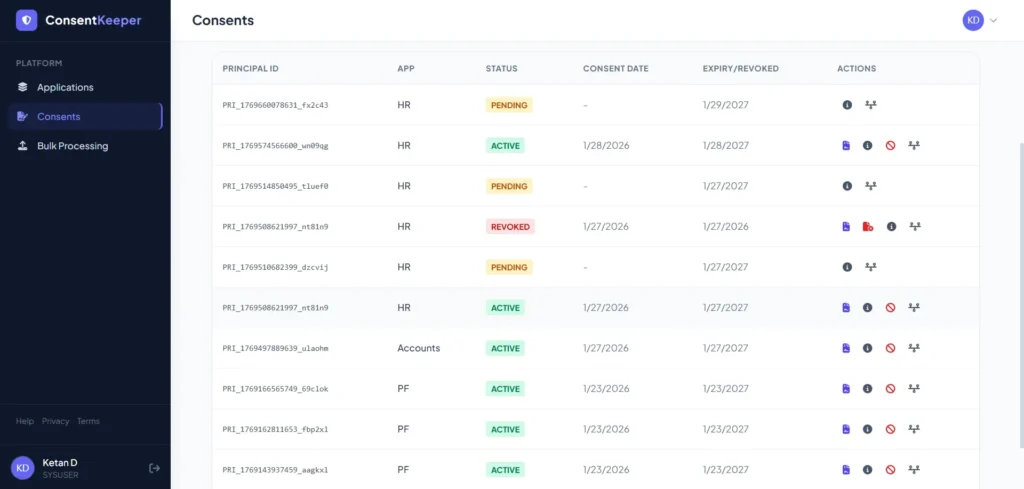
Consent Keeper is a complete DPDP compliance platform designed to automate and simplify compliance.
Here’s how:
1. Automated Consent Collection
Consent Keeper helps you:
- Capture user consent
- Store consent securely
- Provide consent receipts
Supports:
- Websites
- Mobile apps
- Forms
- Call consent
2. Consent Audit Trail
Consent Keeper automatically records:
- Who gave consent
- When consent was given
- What consent was given
- How consent was taken
- This ensures full audit readiness.
3. User Rights Management
Consent Keeper enables users to:
- Withdraw consent
- Request data deletion
- Modify consent
Automatically processes requests.
4. DPDP-Ready Consent Templates
Pre-built templates compliant with DPDP:
- Healthcare consent
- Marketing consent
- Website consent
- Customer onboarding consent
5. Real-Time Compliance Dashboard
Monitor:
- Consent status
- Compliance status
- User requests
- Audit readiness
All in one place.
6. Secure Data Storage
Consent Keeper ensures:
- Encrypted storage
- Secure access
- Legal compliance
7. Breach Risk Reduction
Consent Keeper helps reduce risk by:
- Managing data access
- Tracking consent validity
- Ensuring lawful processing
Benefits of Using Consent Keeper
- Achieve 100% DPDP Compliance
- Avoid legal penalties
- Build customer trust
- Automate compliance
- Reduce manual work
- Stay audit ready
- Improve transparency
Who Should Use Consent Keeper?
Consent Keeper is ideal for:
- Healthcare companies
- Clinics and hospitals
- SaaS companies
- Real estate companies
- Fintech companies
- Insurance companies
- E-commerce companies
- Startups and enterprises
Conclusion
DPDP compliance is essential for every organization handling personal data in India. Manual compliance is risky, time-consuming, and inefficient.
Consent Keeper provides a complete, automated solution to ensure your organization stays fully compliant, secure, and audit-ready.