
Summary
The DPDP Act, 2023 has made data protection a critical responsibility for businesses operating in India.
Organizations must now ensure:
- Proper consent collection
- Transparent privacy policies
- Secure data storage
- User rights management
- Audit trails for compliance
A structured DPDP Compliance Checklist helps organizations implement these requirements step by step.
However, manual compliance processes can be complex and error-prone.
Platforms like Consent Keeper simplify DPDP compliance by providing automated consent management, secure record keeping, and compliance audit trails.
By adopting the right tools and processes, businesses can not only comply with the DPDP Act but also build trust with customers and protect sensitive data.
Table of Contents
Introduction
India’s Digital Personal Data Protection (DPDP) Act, 2023 has changed how organizations collect, process, and store personal data. Businesses that handle customer data must now ensure clear consent, transparency, secure storage, and proper data management practices.
However, many companies still struggle with one question:
“What exactly do we need to do to comply with the DPDP Act?”
This is where a DPDP Compliance Checklist becomes essential. It helps organizations systematically implement the legal requirements and avoid penalties.
In this guide, we will cover:
- What the DPDP Act requires from businesses
- A practical DPDP compliance checklist
- Common compliance mistakes companies make
How tools like Consent Keeper help automate DPDP compliance
What is the DPDP Act?
The Digital Personal Data Protection (DPDP) Act, 2023 is India’s first comprehensive data protection law designed to regulate how organizations collect and process personal data of individuals (Data Principals).
The Act focuses on three key principles:
- Consent-based data processing
- Data protection and security
- Transparency and accountability
Organizations that collect personal data—such as websites, apps, SaaS platforms, banks, healthcare providers, e-commerce platforms, and educational institutions—must comply with DPDP requirements.
Failure to comply can lead to significant penalties that may go up to ₹250 crore per violation.
Because of this, businesses are actively searching for a DPDP compliance checklist to ensure they meet regulatory obligations.
Why Businesses Need a DPDP Compliance Checklist
The DPDP Act introduces multiple requirements such as:
- Consent management
- Data processing records
- Data security measures
- User rights management
- Data breach reporting
- Data retention policies
Without a structured checklist, organizations often face:
- Unclear consent collection processes
- Poor documentation of user data
- No audit trail for compliance
- Risk of regulatory penalties
A DPDP compliance checklist provides a step-by-step roadmap to implement the required policies and systems.
Complete DPDP Compliance Checklist for Businesses
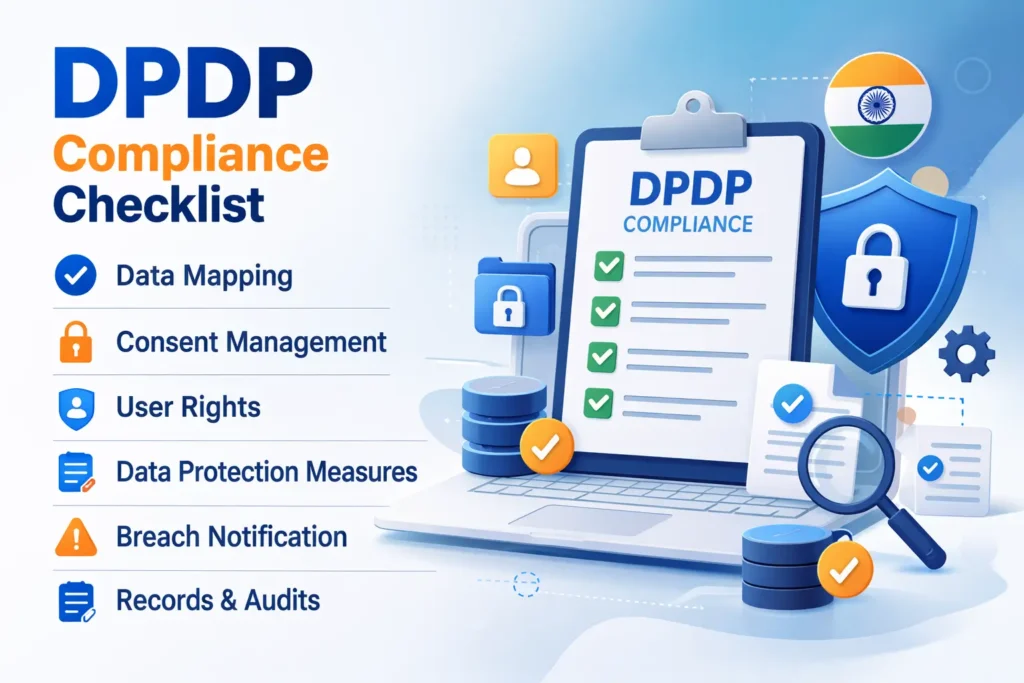
Below is a practical checklist businesses should follow to achieve DPDP compliance.
1. Identify Personal Data You Collect
The first step in DPDP compliance is understanding what personal data your organization collects.
Common types include:
Name
Email address
Phone number
Aadhaar or KYC documents
Location data
Financial information
Behavioral or browsing data
Organizations should conduct a data inventory or data mapping exercise to identify:
What data is collected
Where it is stored
Who has access to it?
Why is it collected
This step forms the foundation of your DPDP compliance strategy.
2. Implement Proper Consent Collection
Under the DPDP Act, personal data can only be processed with valid consent.
Consent must be:
Freely given
Specific
Informed
Unambiguous
This means organizations must clearly inform users about:
What data is collected
Why is it collected
How it will be used
How long will it be stored
Consent must also be easily revokable.
Many businesses struggle to manage consent records manually. This is where a consent management platform like Consent Keeper becomes valuable.
3. Provide Clear Privacy Notices
Every organization must provide a transparent privacy notice explaining:
Data collection purpose
Data processing activities
Data retention period
User rights under DPDP
Contact information for grievances
The privacy notice should be:
Written in simple language
Easily accessible on the website or application
Available at the time of consent collection
4. Enable User Rights Management
Under the DPDP Act, individuals (Data Principals) have rights such as:
Right to access personal data
Right to correct inaccurate data
Right to erase personal data
Right to withdraw consent
Right to grievance redressal
Organizations must create a process or portal where users can submit these requests.
Failure to respond to these requests can result in regulatory action.
5. Maintain Consent and Data Processing Records
One of the most critical requirements of the DPDP Act is maintaining records of consent and data processing activities.
Organizations must be able to demonstrate:
When consent was collected
What users agreed to
How the data was processed
When consent was withdrawn
This requires secure audit trails and proper record management.
Manual tracking through spreadsheets is risky and inefficient.
6. Implement Data Security Measures
Businesses must protect personal data against:
Unauthorized access
Data leaks
Cyber attacks
Accidental loss
Recommended security measures include:
Encryption
Access control
Secure storage
Regular security audits
Data breach response plans
Strong cybersecurity practices are essential for DPDP compliance.
Establish Data Retention Policies
Organizations should not retain personal data indefinitely.
A data retention policy must define:
How long is personal data stored
When it should be deleted
When it should be anonymized
This ensures compliance with DPDP’s principle of purpose limitation and data minimization.
8. Create a Data Breach Response Plan
If a personal data breach occurs, organizations must:
Detect the breach quickly
Contain the impact
Notify authorities when required
Inform affected individuals if necessary
A proper incident response plan is a key part of the DPDP compliance checklist.
9. Appoint Responsible Personnel
Many organizations appoint a Data Protection Officer (DPO) or compliance team to manage DPDP requirements.
Their responsibilities include:
Overseeing data protection practices
Handling user grievances
Maintaining compliance documentation
Coordinating with regulators
10. Implement a Consent Management Platform
Managing consent, user rights, audit trails, and compliance records manually is extremely difficult.
Businesses are increasingly adopting automated DPDP compliance platforms to simplify the process.
One such platform is Consent Keeper.
How Consent Keeper Helps with DPDP Compliance
Consent Keeper is designed to help organizations collect, manage, and track user consent in compliance with the DPDP Act.
It simplifies complex compliance requirements through automation.
Key features include:
Consent Collection
Consent Keeper allows businesses to collect clear and verifiable user consent through digital forms and consent banners.
Secure Consent Storage
All consent records are stored securely, ensuring businesses can demonstrate compliance during audits.
Audit Trails
Every consent action is logged with timestamps and records, creating a complete compliance trail.
User Rights Management
Consent Keeper enables organizations to manage data access, correction, and deletion requests efficiently.
Compliance Documentation
The platform helps maintain the documentation required to prove DPDP compliance to regulators.
Easy Integration
Consent Keeper can be integrated with websites, apps, CRMs, and enterprise systems.
This makes it easier for businesses to adopt a structured and automated approach to DPDP compliance.
Common DPDP Compliance Mistakes Businesses Make
Many companies unknowingly make mistakes that increase compliance risks.
Some common mistakes include:
Collecting data without proper consent
Many websites still collect user information through forms without clear consent language.
No consent record storage
Organizations often fail to maintain proof of user consent.
Unclear privacy policies
Complex or vague privacy notices can violate DPDP transparency requirements.
No data deletion process
Businesses frequently store personal data indefinitely.
No audit trail
Without proper logs, organizations cannot prove compliance.
Using a structured DPDP compliance checklist and automated tools can help avoid these mistakes.
Frequently Asked Questions (FAQ)
The DPDP Act allows authorities to impose penalties of up to ₹250 crore for serious violations, depending on the nature of the offense.
Consent Keeper helps businesses manage DPDP requirements by providing:
- Digital consent collection
- Secure consent record storage
- Compliance audit trails
- User rights management
- Automated compliance workflows