Summary
The DPDP Act requires organizations to implement structured consent mechanisms, data minimization, purpose limitation, security safeguards, and rights management processes. Managing these obligations manually increases the risk of penalties and reputational harm. DPDP Act Compliance Management Solution like Consent Keeper centralizes consent tracking, automates audit trails, manages data subject rights, monitors data flows, and ensures policy enforcement across systems. Investing in the right compliance software transforms regulatory compliance from a burden into a competitive advantage.
Table of Contents
Introduction
India’s Digital Personal Data Protection Act, 2023 (DPDP Act) has introduced a new era of accountability for organizations handling personal data. As businesses digitize operations, collect customer information, and rely on data-driven decisions, compliance with the DPDP Act is no longer optional — it is mandatory.
However, compliance is complex. It involves consent tracking, data lifecycle management, audit readiness, vendor oversight, breach response mechanisms, and user rights management. Manual processes are not only inefficient but also risky.
This is where DPDP Act Compliance Management Software becomes essential. Platforms like Consent Keeper simplify compliance by automating consent capture, tracking, reporting, and governance processes — helping organizations stay compliant while focusing on growth.
In this blog, we explore what DPDP compliance management software is, why it is necessary, its key features, and how Consent Keeper empowers businesses to navigate regulatory requirements confidently.
Understanding the Need for DPDP Act Compliance Management Software
The DPDP Act mandates that organizations:
- Obtain clear and informed consent.
- Process data only for specified purposes.
- Implement reasonable security safeguards.
- Provide individuals with access, correction, and erasure rights.
- Maintain accountability and documentation.
- Prevent unauthorized data retention.
For businesses managing thousands or millions of user records, fulfilling these obligations manually is nearly impossible. Spreadsheets, disconnected systems, and siloed teams create compliance blind spots.
Compliance management software centralizes and automates these processes, reducing risk and ensuring consistent policy enforcement.
What is DPDP Act Compliance Management Software?
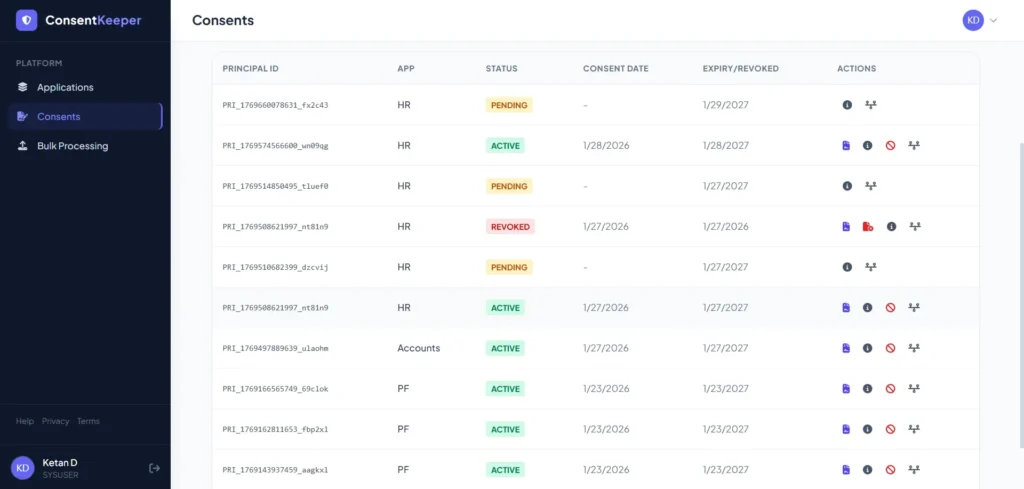
DPDP Act Compliance Management Software is a digital platform that helps organizations:
- Capture valid consent
- Track consent lifecycle
- Maintain audit logs
- Manage data subject rights
- Monitor data processing activities
- Generate compliance reports
- Align internal systems with regulatory requirements
It acts as a centralized governance layer across digital systems, ensuring personal data handling aligns with DPDP Act provisions.
Key Compliance Challenges Businesses Face
Before exploring features, it’s important to understand the core compliance pain points:
1. Scattered Consent Records
Consent captured across websites, apps, CRM systems, and offline channels often remains fragmented.
2. Lack of Data Visibility
Organizations struggle to map where personal data is stored and processed.
3. Delayed Response to User Requests
Manual workflows slow down handling of access or deletion requests.
4. Audit Preparedness Issues
Many companies cannot produce documented proof of compliance.
5. Vendor Risk
Data shared with third-party vendors may not be properly governed.
DPDP Act compliance software addresses these challenges systematically.
Core Features of DPDP Compliance Management Software
1. Centralized Consent Management
Consent is the foundation of the DPDP Act. Software solutions:
- Capture purpose-specific consent.
- Maintain timestamped records.
- Store consent withdrawal logs.
- Link consent to user profiles.
Consent Keeper ensures that every consent interaction is securely recorded and retrievable during audits.
2. Purpose Limitation Controls
The DPDP Act requires data to be used only for declared purposes.
Compliance software:
- Tags data to specific purposes.
- Restricts unauthorized reuse.
- Alerts administrators if usage deviates from consent terms.
Consent Keeper enables organizations to configure and enforce purpose-based data policies across systems.
3. Automated Data Subject Rights Management
Users can request:
- Access to their data
- Correction of inaccuracies
- Deletion (erasure)
Software platforms provide:
- Ticket-based workflows
- Automated request logging
- SLA tracking
- Action history documentation
Consent Keeper simplifies rights management, ensuring requests are handled within defined timelines.
4. Data Retention and Deletion Controls
DPDP requires data to be retained only as long as necessary.
Compliance software helps by:
- Setting retention timelines
- Sending expiration alerts
- Automating data deletion workflows
- Documenting deletion events
Consent Keeper supports lifecycle management, preventing over-retention and reducing risk exposure.
5. Audit Trails and Reporting
Regulators may request proof of compliance.
A strong compliance management system provides:
- Real-time dashboards
- Consent activity reports
- User request logs
- Vendor data-sharing records
Consent Keeper generates audit-ready documentation instantly, reducing stress during inspections.
6. Vendor and Third-Party Oversight
Organizations remain accountable even when vendors process data.
Compliance software:
- Tracks vendor access
- Logs data-sharing events
- Stores contractual compliance documents
Consent Keeper enables structured vendor governance, helping businesses monitor third-party compliance effectively.
7. Security Integration
Security safeguards are a key requirement under the DPDP Act.
Compliance software integrates with:
- Access control systems
- Encryption protocols
- Authentication systems
- Breach notification workflows
Consent Keeper ensures secure storage of consent records and encrypted data transmission.
Why Businesses Need Consent Keeper
Consent Keeper is more than just a consent tool — it is a comprehensive DPDP compliance management platform designed to align organizations with India’s evolving privacy landscape.
Here’s how Consent Keeper stands out:
1. Purpose-Based Consent Framework
Consent Keeper allows granular consent collection for different processing purposes — marketing, analytics, service delivery, and more.
2. Seamless System Integration
It integrates with CRM platforms, ERP systems, marketing tools, and customer databases, ensuring consistent policy enforcement across digital ecosystems.
3. Automated Audit Readiness
With built-in reporting dashboards, organizations can instantly generate compliance reports.
4. Consent Expiry Management
Automated reminders ensure consent remains valid and up to date.
5. Scalable for Enterprises
Whether handling thousands or millions of records, Consent Keeper scales efficiently.
6. User-Friendly Interface
Simple dashboards and structured workflows make compliance manageable even for non-technical teams.
Benefits of Using DPDP Compliance Solution
Reduced Risk of Penalties
Automated controls minimize human error.
Improved Operational Efficiency
Automation reduces manual workload and repetitive tasks.
Enhanced Customer Trust
Transparent consent practices strengthen brand credibility.
Faster Audit Response
Centralized documentation simplifies regulator interactions.
Competitive Advantage
Privacy-first businesses gain a strong market position.
Implementing DPDP Compliance Solution: Best Practices
- Conduct a data audit before implementation.
- Identify all data collection points.
- Define consent purposes clearly.
- Configure retention timelines.
- Train employees on system usage.
- Regularly review compliance reports.
- Update processes when regulations evolve.
Successful implementation requires alignment between legal, IT, operations, and compliance teams.
Future of Compliance Management in India
As digital ecosystems expand, regulatory oversight will intensify. Organizations must prepare for:
- Increased regulatory audits
- Stronger data governance expectations
- AI-driven data processing scrutiny
- Greater public awareness of privacy rights
Compliance software will evolve from being optional to becoming a core operational infrastructure component.
Consent Keeper positions organizations ahead of the curve by embedding compliance directly into business systems.
Frequently Asked Questions (FAQ)
It is a digital platform that helps organizations manage consent, data subject rights, data retention, and audit documentation to meet DPDP Act requirements.
The Act does not mandate specific software, but structured systems are essential to demonstrate compliance effectively.
Yes. Consent Keeper is scalable and suitable for startups, SMEs, and large enterprises.
Consent records are securely stored with timestamps, purpose details, and withdrawal logs for audit readiness.
No. It complements legal advice by implementing policies operationally and technically.
Organizations should review reports quarterly and after major system changes.
Processing must stop for the specified purpose, and the system should trigger appropriate data deletion or restriction workflows.
Conclusion
The DPDP Act represents a transformative shift in India’s data protection framework. Compliance is no longer a policy document — it is a continuous operational responsibility.
Manual tracking methods are insufficient in today’s data-intensive environment. Businesses need structured, automated systems to manage consent, document processing activities, respond to user requests, and prepare for audits.
DPDP Act Compliance Management Solution like Consent Keeper provides the tools necessary to simplify compliance, reduce risk, and build trust. By investing in the right technology today, organizations not only protect themselves from penalties but also position themselves as responsible custodians of personal data in a privacy-conscious digital economy.